Showing posts with label fundamental research. Show all posts

Tuesday, April 09, 2024

Unlocking Profit Potential in the Indian Stock Market: Strategies for Success

Investing in the Indian stock market can be both exhilarating and daunting. While some investors rely on thorough research and analysis to make informed decisions, others may wonder if it's possible to profit without a clear reason or by sidestepping the virtual losses that often occur. In this article, we'll explore strategies to navigate the complexities of the Indian stock market and potentially earn profits while minimizing losses.

Understanding Market Dynamics:
Before delving into strategies, it's crucial to grasp the fundamental dynamics of the Indian stock market. It's a volatile arena influenced by various factors, including economic indicators, geopolitical events, corporate performance, and investor sentiment. While some investors thrive on market volatility, others may find it intimidating. However, volatility also presents opportunities for profit if approached strategically.

Strategies for Profit:

1. Technical Analysis:
Technical analysis involves studying historical price and volume data to identify patterns and trends. While it doesn't focus on the intrinsic value of stocks, it provides insights into market sentiment and short-term price movements. Traders often use tools like moving averages, relative strength index (RSI), and MACD (Moving Average Convergence Divergence) to make trading decisions. By mastering technical analysis, investors can capitalize on short-term price fluctuations and generate profits without necessarily relying on fundamental reasons.

2. Momentum Trading:
Momentum trading involves buying stocks that are exhibiting upward momentum and selling them as they lose steam. This strategy relies on the belief that stocks that have performed well in the past will continue to do so in the short term. Investors can identify momentum stocks using various indicators such as price trends, trading volume, and relative strength compared to the overall market. By riding the momentum wave, investors can potentially make profits without delving into the underlying reasons for stock movements.

3. Swing Trading:
Swing trading involves capturing short- to medium-term price movements within a trend. Unlike day trading, which involves buying and selling within the same trading day, swing traders hold positions for several days or weeks. This strategy leverages both technical and fundamental analysis to identify entry and exit points. By focusing on capturing price swings, swing traders can potentially profit from market fluctuations without being overly concerned about the reasons behind them.

4. Risk Management:
Regardless of the strategy employed, effective risk management is paramount in the stock market. Investors should define their risk tolerance and set stop-loss orders to limit potential losses. Additionally, diversification across sectors and asset classes can help mitigate risk. By managing risk effectively, investors can safeguard their capital and position themselves for long-term success.

Avoiding Virtual Losses:

While it's tempting to ignore losses and hope for a recovery, it's essential to address them proactively. Investors should cut their losses short by adhering to predetermined stop-loss levels. Additionally, focusing on strategies that prioritize risk management can help mitigate virtual losses and preserve capital. By staying disciplined and avoiding emotional decision-making, investors can navigate market downturns more effectively.

Conclusion:
While making profits in the Indian stock market without a clear reason may seem challenging, it's not impossible. By employing strategies such as technical analysis, momentum trading, swing trading, and effective risk management, investors can potentially capitalize on market opportunities and generate profits. However, it's essential to approach trading with caution and discipline to minimize losses and maximize returns in the dynamic and ever-changing landscape of the Indian stock market.

✓ To improve your Investment Journey in Indian Stock Market, we invite you to visit our website.
https://www.infostock.in

Monday, March 04, 2024

Understanding the Dynamics of Stock Market Fluctuations

Many new investors easily get influenced by the stories of successful big investors in the world who created their wealth in crores in the stock market. They open a demat account and without having basics of investment they start their investment journey with trading stocks.

The stock market is a complex ecosystem where prices of individual stocks are influenced by a multitude of factors, both internal and external. Understanding why a stock rises or falls can be challenging, but there are several main reasons that can shed light on these fluctuations.

1. Economic Indicators: One of the primary drivers of stock movements is the overall health of the economy. Economic indicators such as GDP growth, unemployment rates, inflation, and consumer spending can significantly impact investor sentiment. Positive economic data often leads to increased confidence among investors, causing stocks to rise, while negative data can have the opposite effect.

2. Company Performance: The performance of the company itself plays a crucial role in determining the direction of its stock price. Factors such as quarterly earnings reports, revenue growth, profit margins, and guidance for future performance can influence investor perceptions of a company's prospects. Positive earnings surprises or strong growth prospects can lead to stock price appreciation, while disappointing results may result in a decline.

3. Market Sentiment: Investor sentiment, or the overall mood of market participants, can heavily influence stock prices in the short term. Factors such as news events, geopolitical tensions, and market rumors can impact sentiment and drive buying or selling activity. For example, positive news about a company's new product launch or a merger announcement can boost investor confidence and lead to a rise in its stock price.

4. Interest Rates and Monetary Policy: Changes in interest rates and monetary policy set by central banks can have a significant impact on stock prices. Lower interest rates generally make stocks more attractive relative to other investments, leading to increased buying activity and higher stock prices. Conversely, higher interest rates can dampen investor enthusiasm for stocks, leading to price declines.

5. Industry Trends and Competition: Industry-specific factors can also influence the performance of individual stocks. Trends such as technological advancements, changes in consumer preferences, regulatory developments, and competitive pressures can all impact a company's ability to generate profits and grow its business. Companies that are well-positioned to capitalize on emerging trends or that have a competitive advantage within their industry are more likely to see their stock prices rise.

6. Supply and Demand Dynamics: The basic economic principles of supply and demand also play a role in stock market fluctuations. When there is high demand for a particular stock and limited supply, its price is likely to rise. Conversely, if there is an oversupply of shares or weak demand from investors, the stock price may fall. Factors such as insider buying or selling, stock buybacks, and institutional trading activity can all affect supply and demand dynamics in the market.

In conclusion, the movement of stock prices in the market is influenced by a complex interplay of economic, financial, and psychological factors. While it is impossible to predict with certainty how a particular stock will perform in the short term, understanding the main drivers of stock market fluctuations can help investors make more informed decisions and navigate the ups and downs of the market with greater confidence.

For more such informative contents and fundamental research reports on Indian Stock Market, please browse Infostock India on Google or social media network.

Thanks for sharing it with others!

Saturday, December 23, 2023

How to create a good portfolio in the stock market ?

Having a good portfolio in the stock market is the greatest desire of every long term investor.

Here are some points to be noted for better returns:

1. Diversification: Spread your investments across different asset classes, sectors, and industries to reduce risk. Don't put all your money in one stock or sector.

2. Research and Analysis: Conduct thorough research on companies before investing. Consider their financial health, growth prospects, management team, and competitive position.

3. Risk Management: Assess your risk tolerance and invest accordingly. Avoid putting all your money into high-risk investments. Balancing riskier stocks with more stable ones can help manage risk.

4. Long-Term Approach: Think long-term when investing. Avoid making impulsive decisions based on short-term market fluctuations. Invest with a mindset of holding quality stocks for the long haul.

5. Regular Review and Rebalancing: Periodically review your portfolio to ensure it aligns with your financial goals and risk tolerance. Rebalance by selling over-performing assets and buying undervalued ones to maintain diversification.

6. Stay Informed: Keep up with market trends, economic indicators, and company news. Continuous learning and staying informed are crucial in making informed investment decisions.

7. Consider Professional Advice: If needed, seek advice from financial advisors or professionals who can provide personalized guidance based on your financial situation and goals.

Creating a good portfolio involves a mix of strategy, research, and regular monitoring to adapt to changing market conditions and personal circumstances.

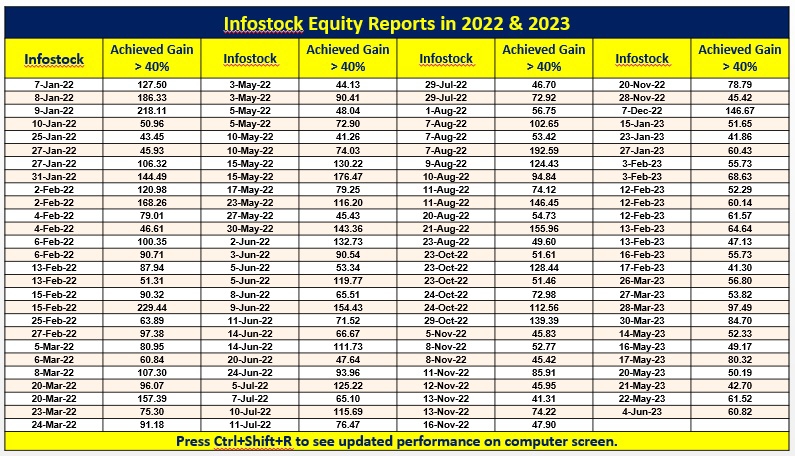
Infostock India has been assisting Indian Investors for last several years with its fundamental research called "Infostock Equity Report". 

It is offered under suitable subscription plans. Please search about it on social media or Google and benefit from it.

Thursday, July 20, 2023

Fundamental Research of Indian Stock Market

We know what is Stock Market, do you know what is Stock Market?

* Visit our website
* Listen to Infostock Podcast
* Browse about us on social media or google images
* Decide if you should focus on your financial security now or later.

Follow us, Share it, Subscribe it

#financialsecurity #stockmarket #nse #moneymantra #fundamentalresearch #investmentplanning #infostockindia

Thursday, January 27, 2022

The best equity research report in India

Fundamental Research for Indian Stock Market Investors

Check past performance on Google images or any social media network now and plan for a secure financial future.

Share the post on social media networks and book it free. Offer valid till 31.01.2022 only.

Why Some Business Models Create Extraordinary Wealth While Others Struggle

Many investors spend countless hours studying financial ratios, quarterly results, and stock price movements. While these are important, the...